Landscape dimensions
Amanda Mei and Laura Gorski
curated by Sonia Salcedo Del Castillo
September 17, 2019 - October 13, 2019
Rio de Janeiro
Amanda Mei and Laura Gorski explore (their own) formulations about landscape through poetic strategies that act at the crossroads between imaginaries: fictions and realities. In the dialog between their productions, we glimpse a field of reinvention of the real that specifically implies affective, existential space-temporalities around the idea-landscape.
In addition to natural elements, this idea includes reflections on being in the world. It is no coincidence that in both productions we see an interest in moving between spaces-places-landscapes in order to problematize them, imaginary or fictional, in the face of their instability.
Whether they are taken as history or as a refuge, in his works we are faced with this idea-landscape, in the form of fragments and overlays (perhaps hints) of what escapes us: both in terms of the orbit of the human scale and the sphere of the apprehension of instants in the face of eternity.
According to our poetic fantasy, these aforementioned hypotheses are welcome because they are present in the investigations of the two artists, as concerns inherent to the relationship between the body and living space and (it must be said) pertinent to our entire civilizing process.
If, in Mei’s way, the rock underpins his inquiries, and in Gorski’s way, questions fall on the horizon, all this is due to the fact that these objects of research are spatio-temporal references of our existence in the world. Anthropomorphically and comparatively: while the rock stands on the threshold between the world and the planet, the horizon brings them closer together, ensuring our mutual coexistence.
Although the poetic roots of the two artists are different – since Mei comes from painting and Gorsky from drawing – their dissimilarities end up pointing to affinities.
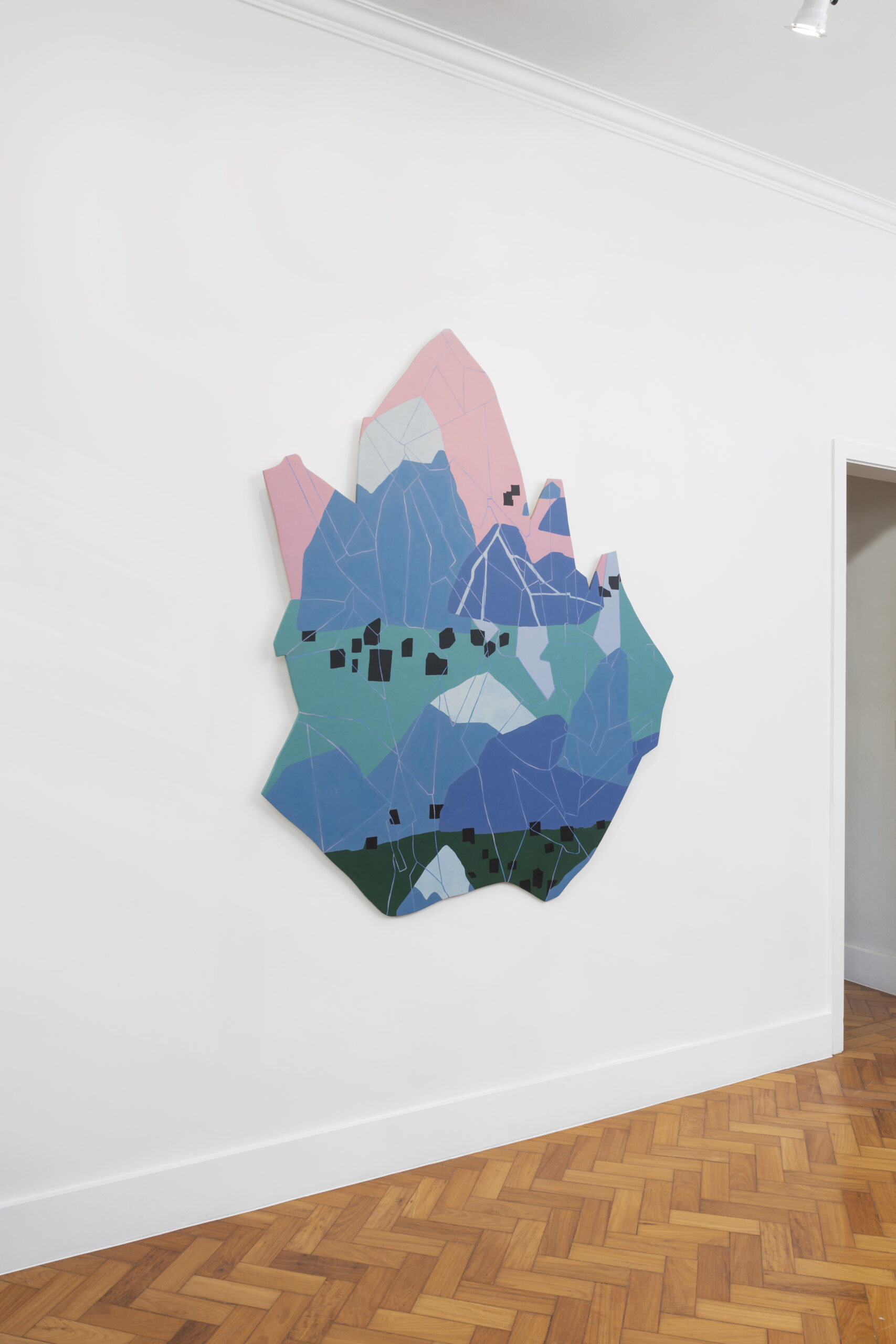
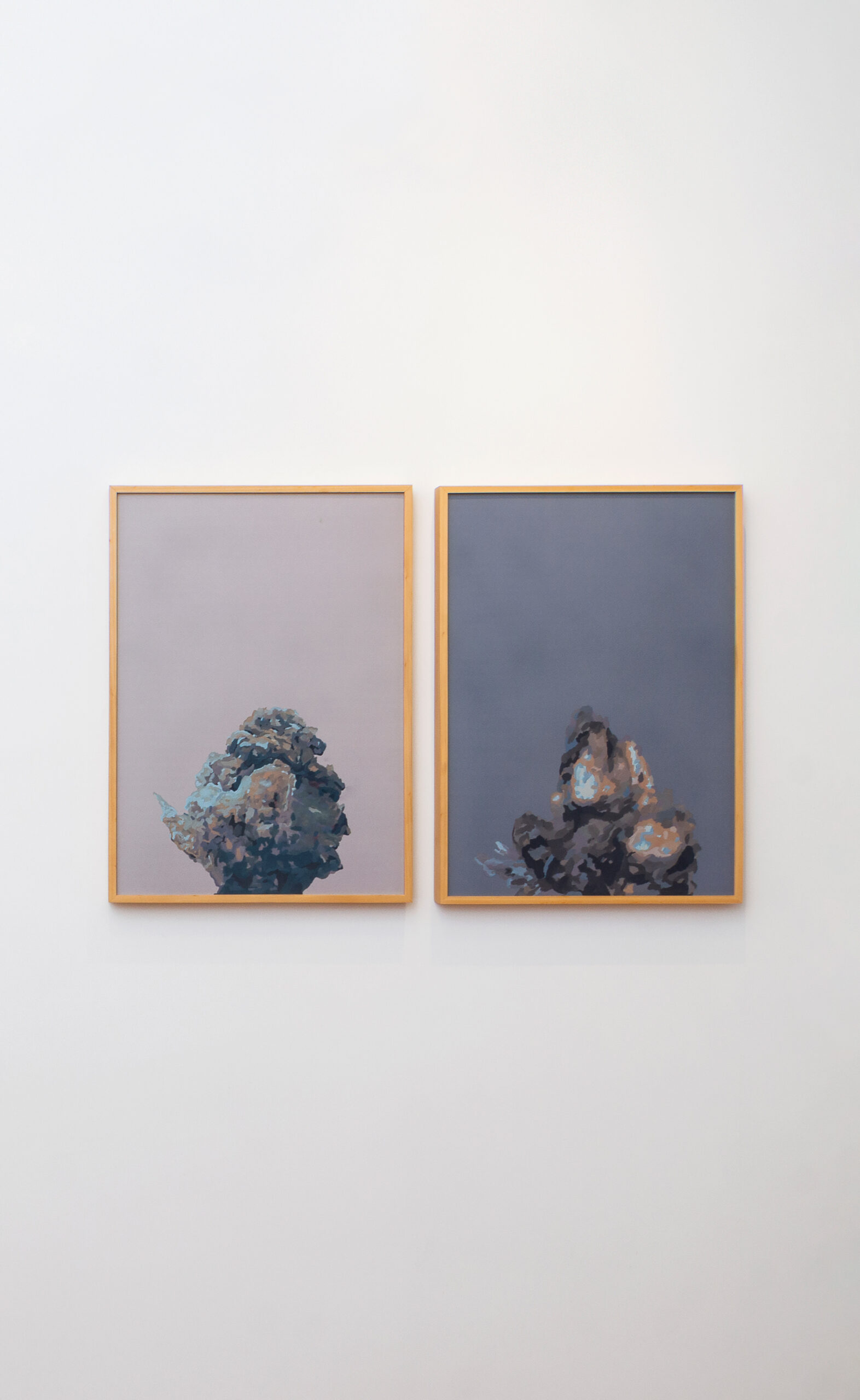
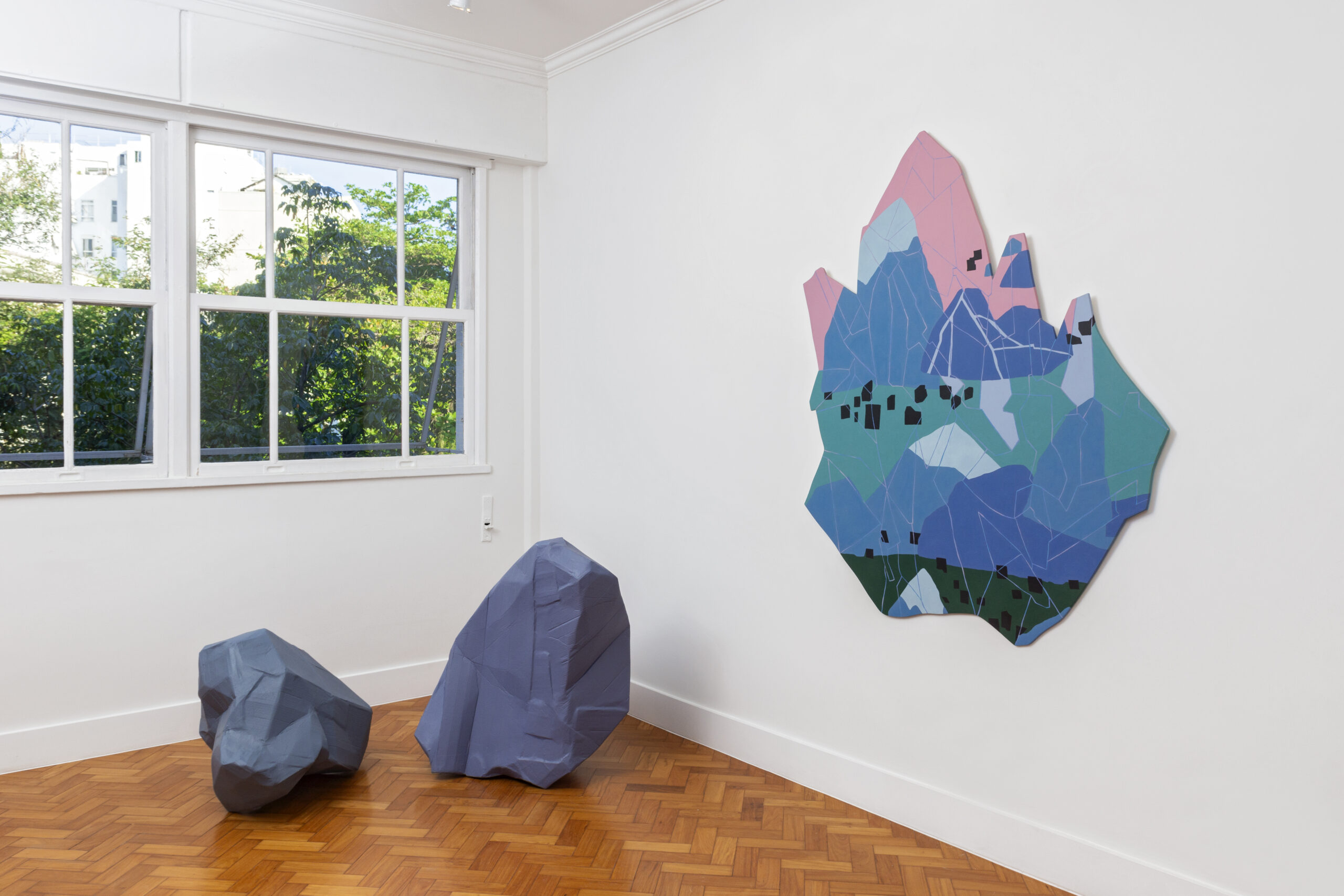
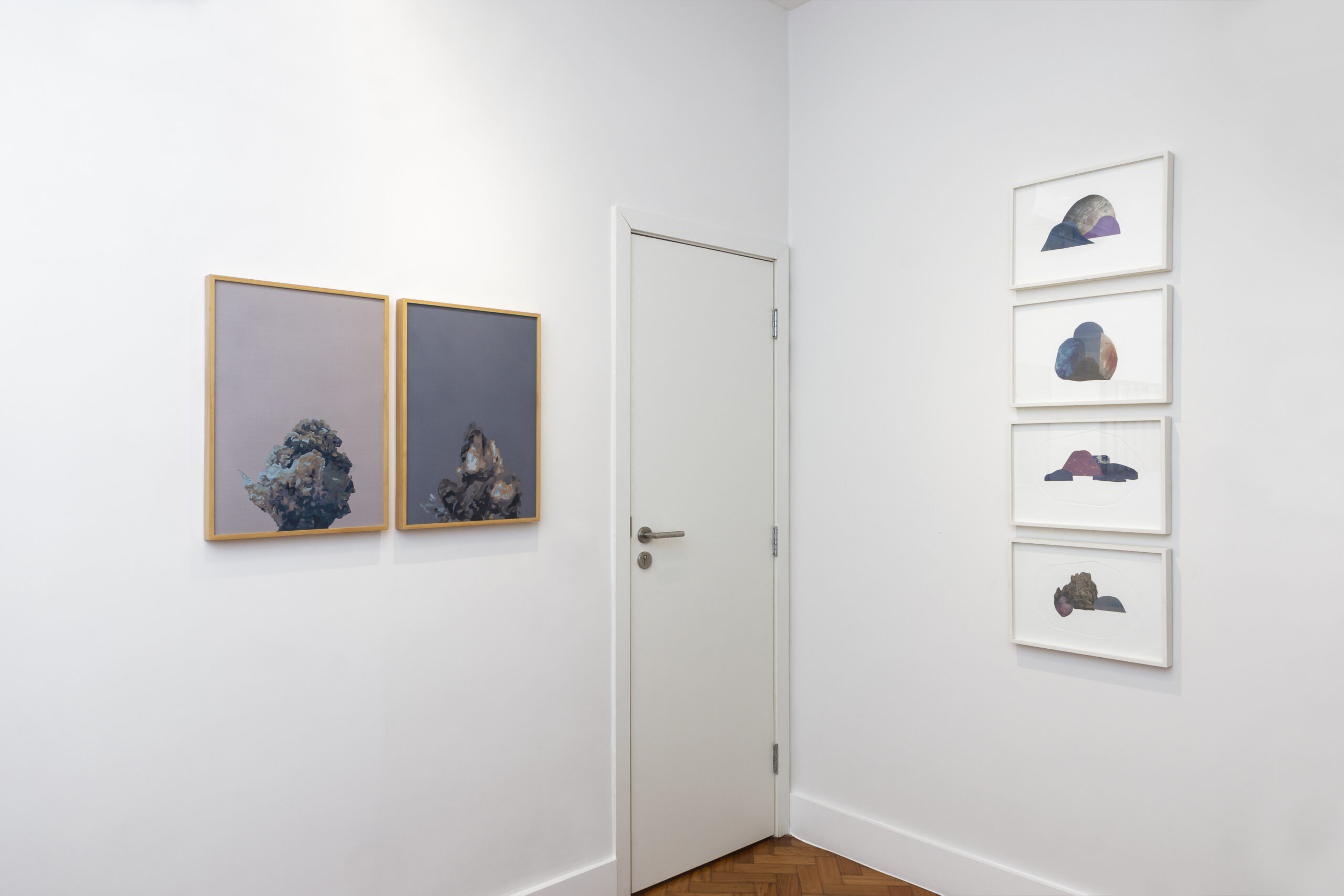
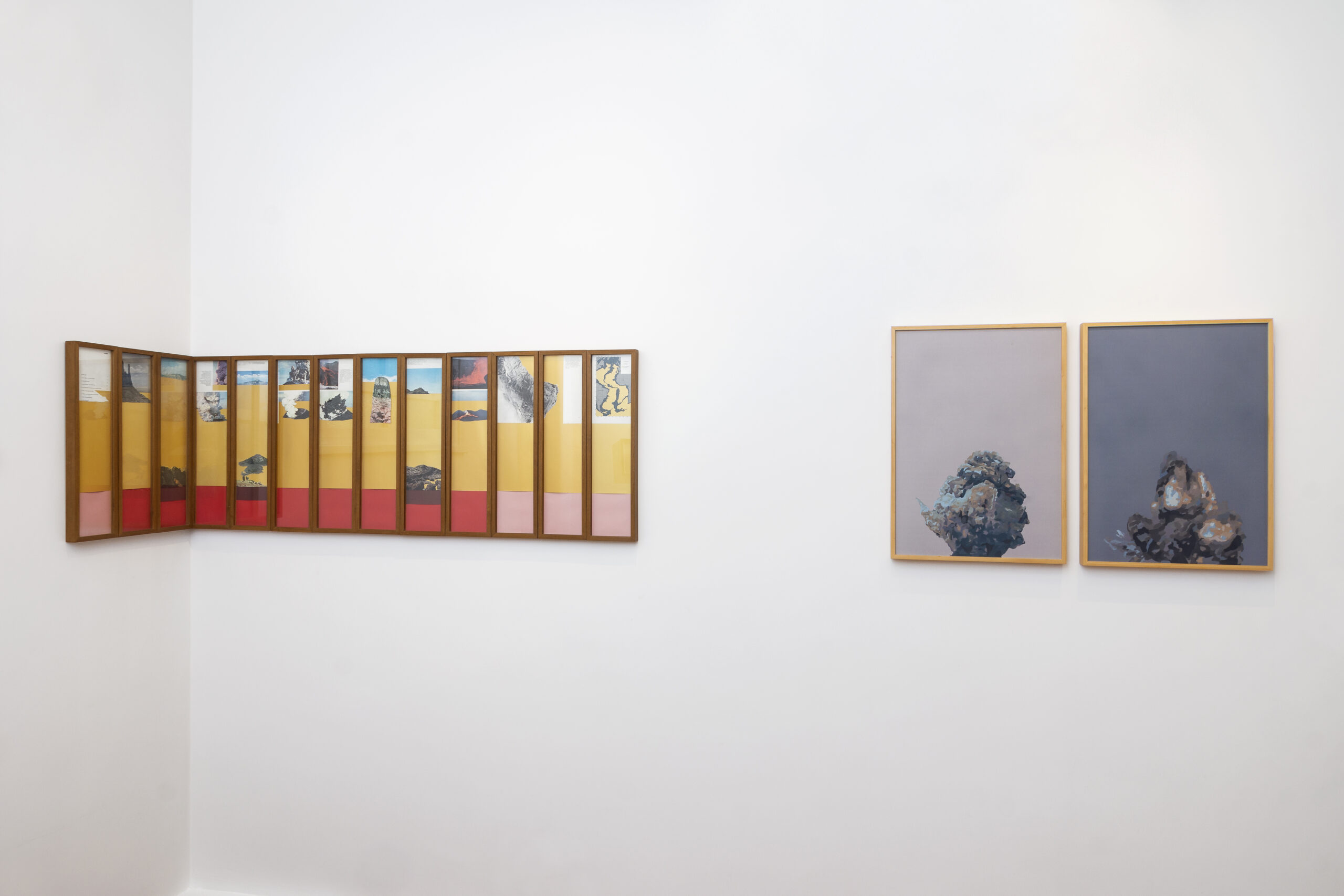
By conceptually thinking about painting outside of conventional supports, Amanda Mei aims to reflect on certain deviations from natural cycles that are imposed by the production chain that surrounds recent socio-economic life. Cardboard as a simulacrum of the surface and structure of works like Meteoros, for example, confirm the fact that the artist takes the materials she uses as a constituent part of her production. As if, fancifully, she could return them to the realms from which they were taken. But not only that. As she dribbles our perception, confronting permanence and ephemerality, she puts on the agenda what seems to be her main object of research: the time/space binomial. It is in this way, then, that the stone becomes a landmark and a moment, at the same time… that works such as Aeolis launch us towards imagined places (like the quadrants of Mars and its rolling stones); or Marked Encounter includes us in a moment towards which everything converges, since in an explosion there is nothing ulterior, not even time (past, present or future). Like a shard from the Big Bang, here is the stone again to tell us about creation… and not least, about reinvention, as in the hybrid series Planetas (Planets), in which, in addition to painting, collage and engraving tell us about the desire to give traces density.
Like someone moving stones in a Japanese garden, Mei is attentive to the moment of being in the world. Between Yin and Yang, a legacy of her oriental origins, as well as a palette alluding to human carelessness with the earth’s atmosphere (in which grey predominates), the artist prioritizes the wisdom of simple, fundamental forms, to the detriment of technological apparatuses that often disregard the relationship between man and nature. This is the principle of Bipolar Nebula: direct intervention in architectural space that outlines rock structures.
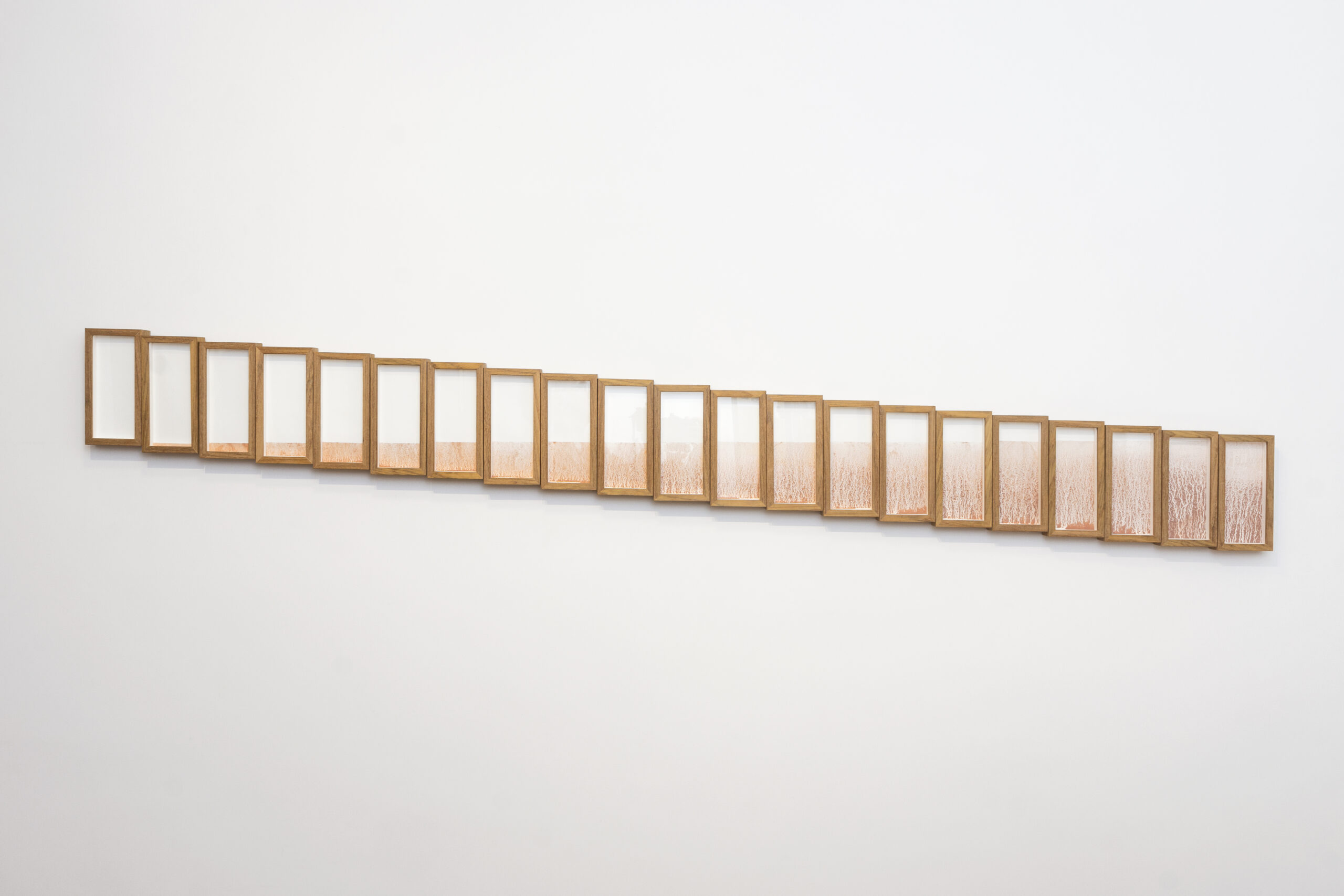
Laura Gorski, on the other hand, has the horizon as the reason for that relationship between man and nature: a structuring line for the space-time perspective of her narrative-landscape, to which everything converges, like an escape or an intimate refuge. It is, therefore, a resting line for the gaze which, in itself, guides the imagination to the landscape-idea and, in a similar way to the drawing, calls for restrained admiration, a contemplation that is not rushed. You see, when the body collides with the landscape, a distanced gaze is called for. So, if the landscape-scale reduces her presence, the horizon becomes a form of self-knowledge for the artist.
By looking outside in order to see inside, Laura simplifies the shapes used in her drawing, reducing their elements in order to find a sense of the landscape as a place of silence and contemplation.
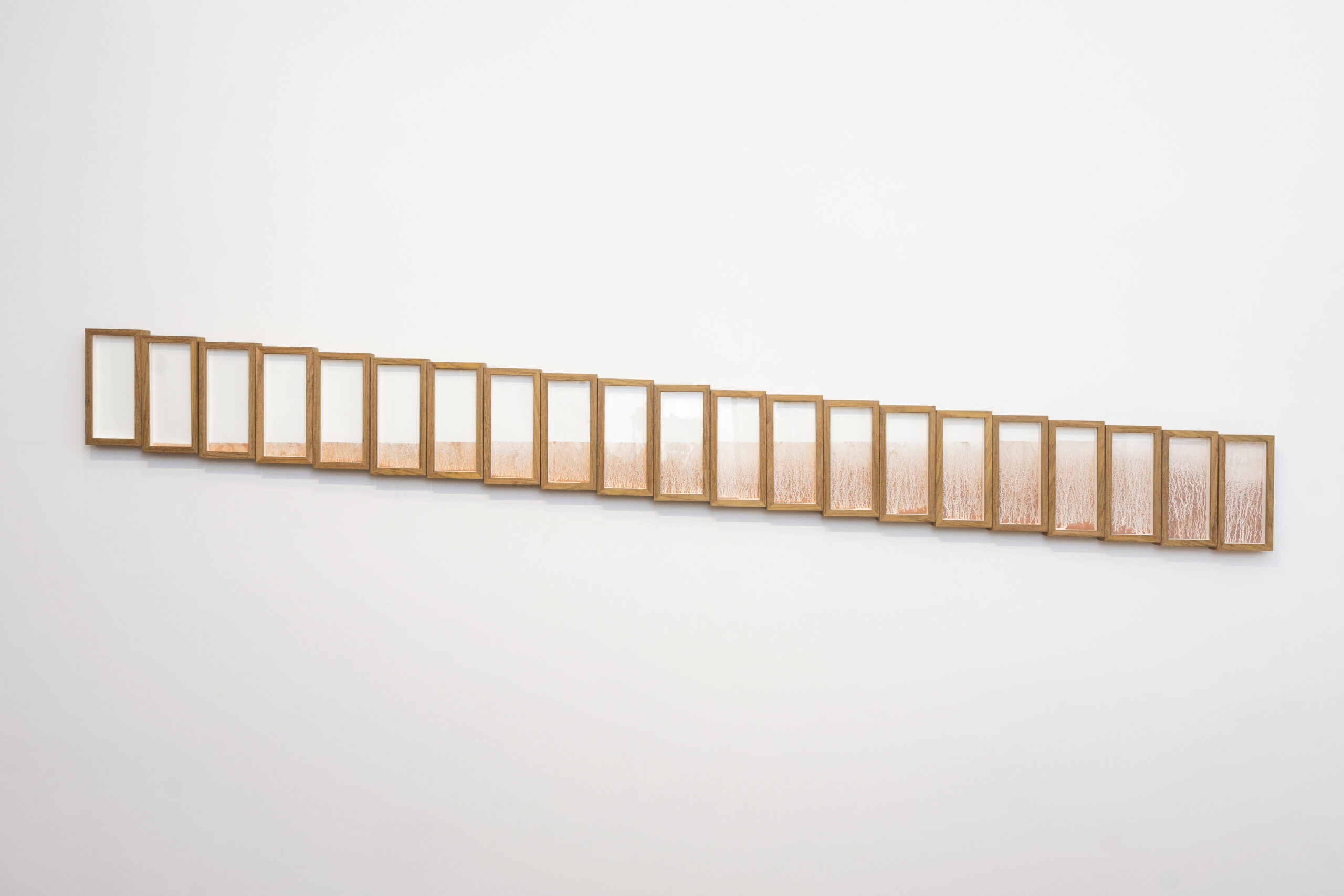
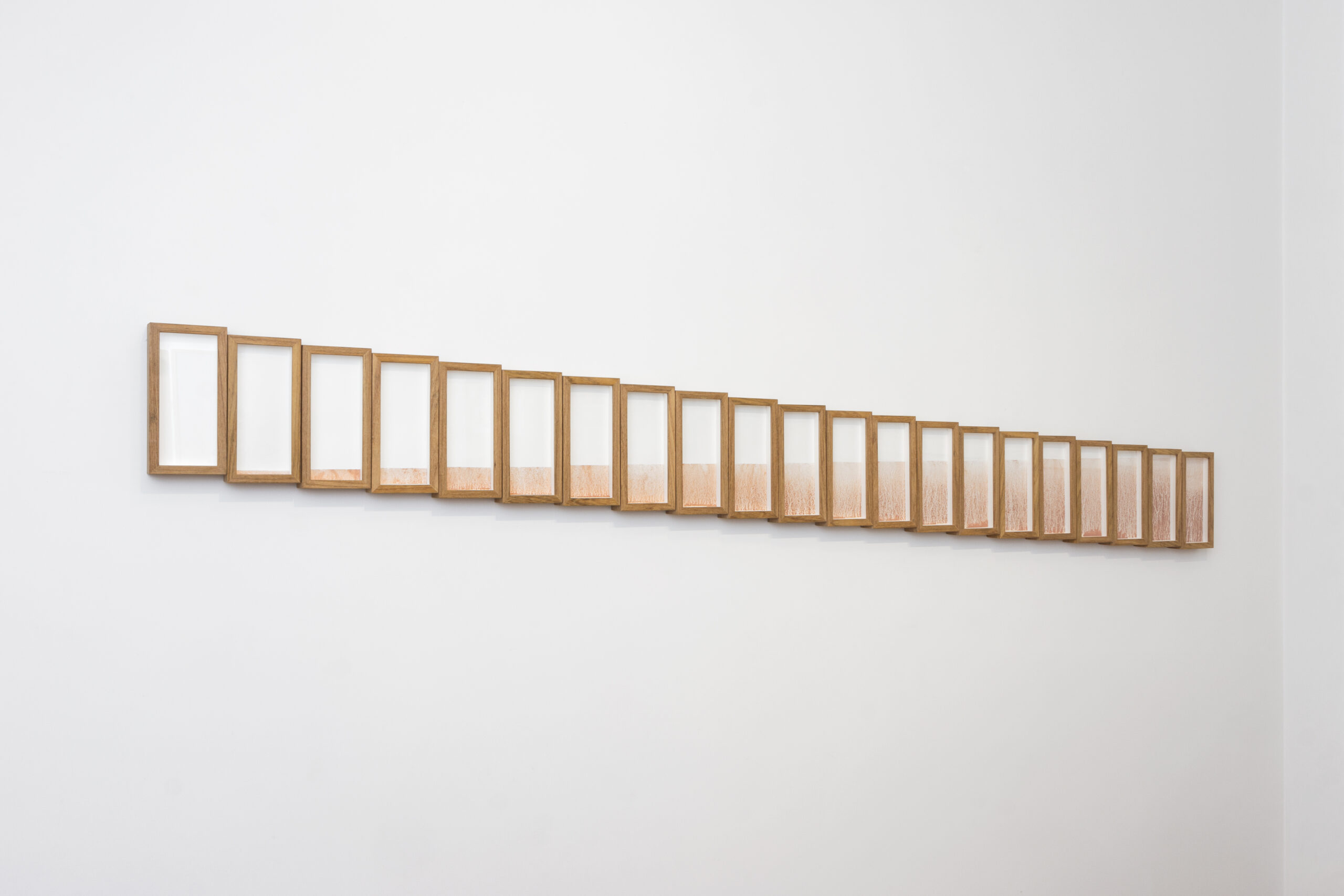
Although Level contains this master line that draws not only the horizon, but also the understanding of all of Gorsky’s works in poetic dialogue with Mei’s production, for example, a certain intimate restlessness of the artist, that of the body and soul that we referred to above, gradually subverts the direction of that line, giving it meaning, so that it is included in her idea-landscape.
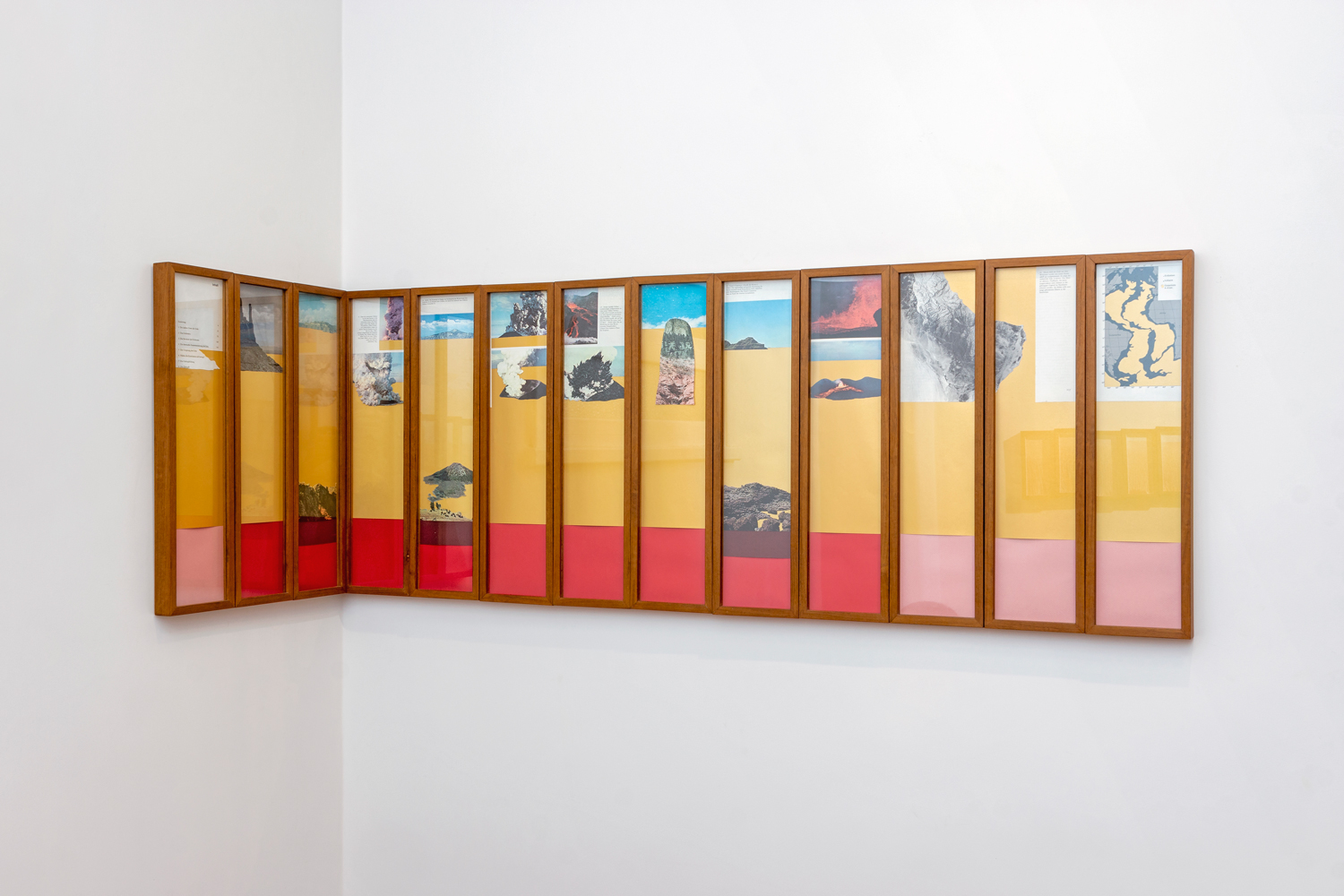
This “subversive” poetic will first manifests itself in Fronteiras de Tempo, a work in which fragmentary thought gives way to overlapping thought. In it, Laura stretches the pages of a book vertically over the formation of abysmal landscapes, like cliffs. By inverting the horizontality of the view, the open book creates a panorama that narrows the gaze.
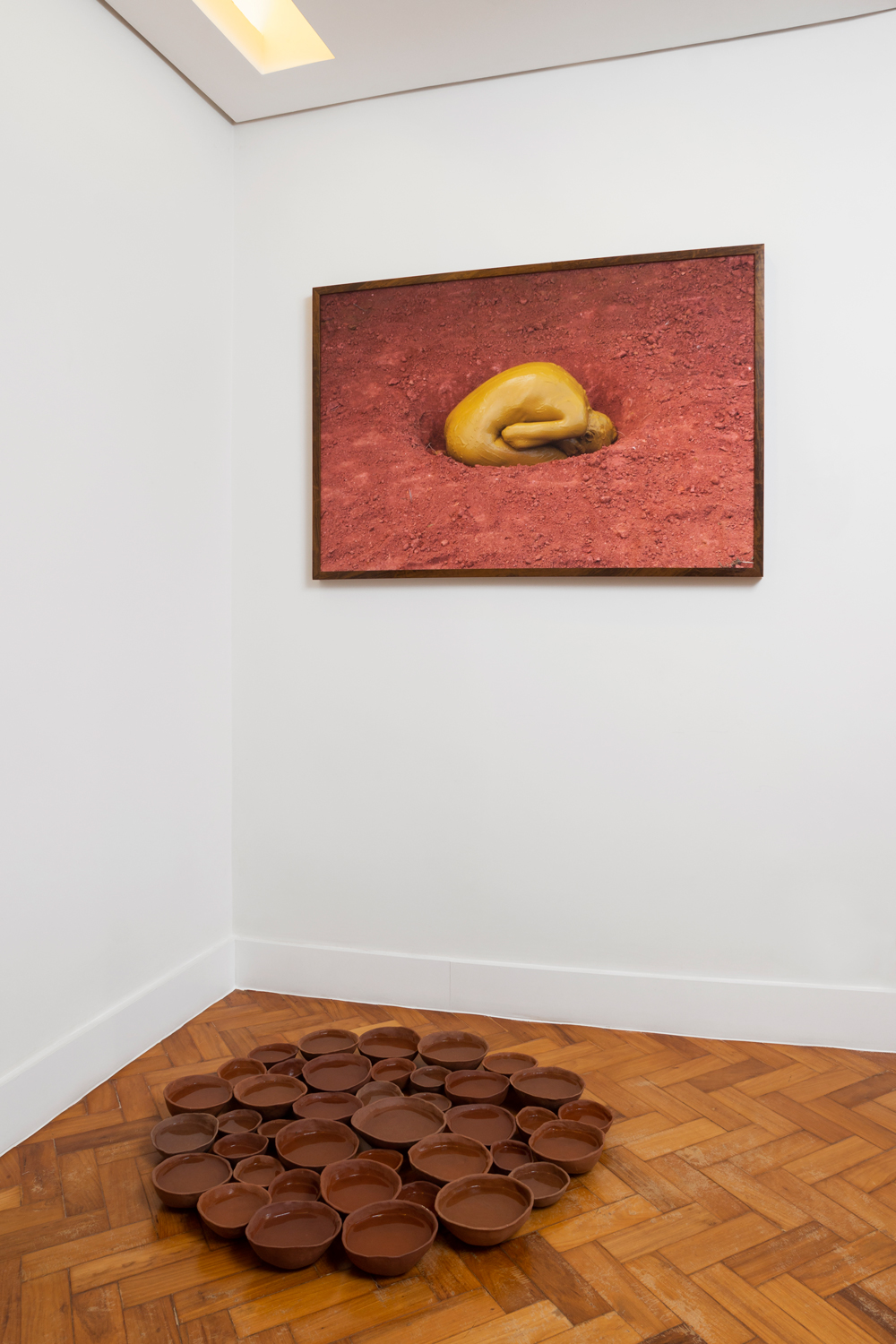
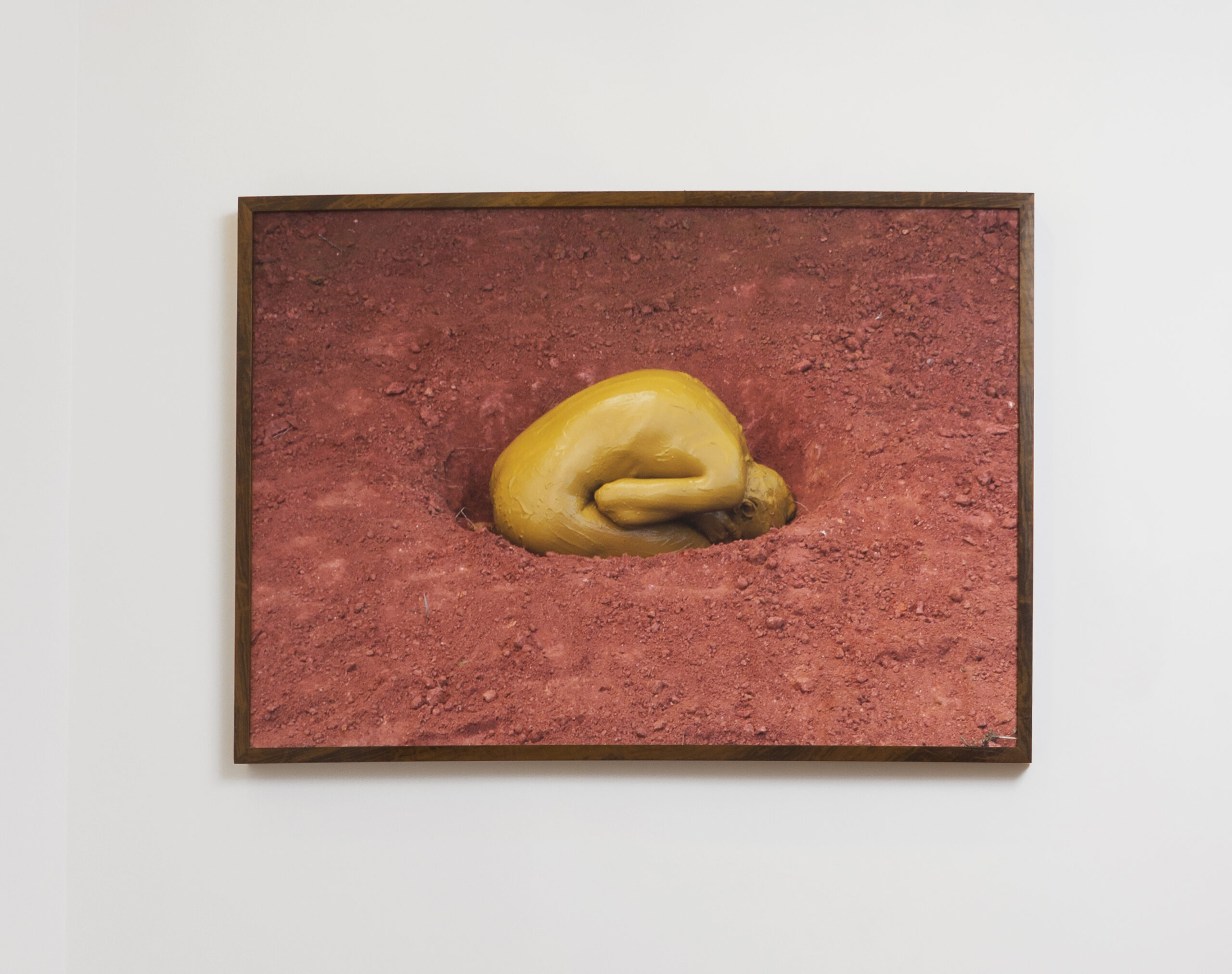
This narrowing comes from an experience the artist had in the Amazon rainforest, given the verticality of the trees and the consequent impossibility of seeing the horizon. Laura then blends into the landscape. Her own body becomes the horizon, in the manner of the striking image in Ser Paisagem, in which, inseparably, artist and work result in an end in themselves. A point of softness and nobility tattooing the earth. Made of filigree value that sacralizes its own meditative projection.
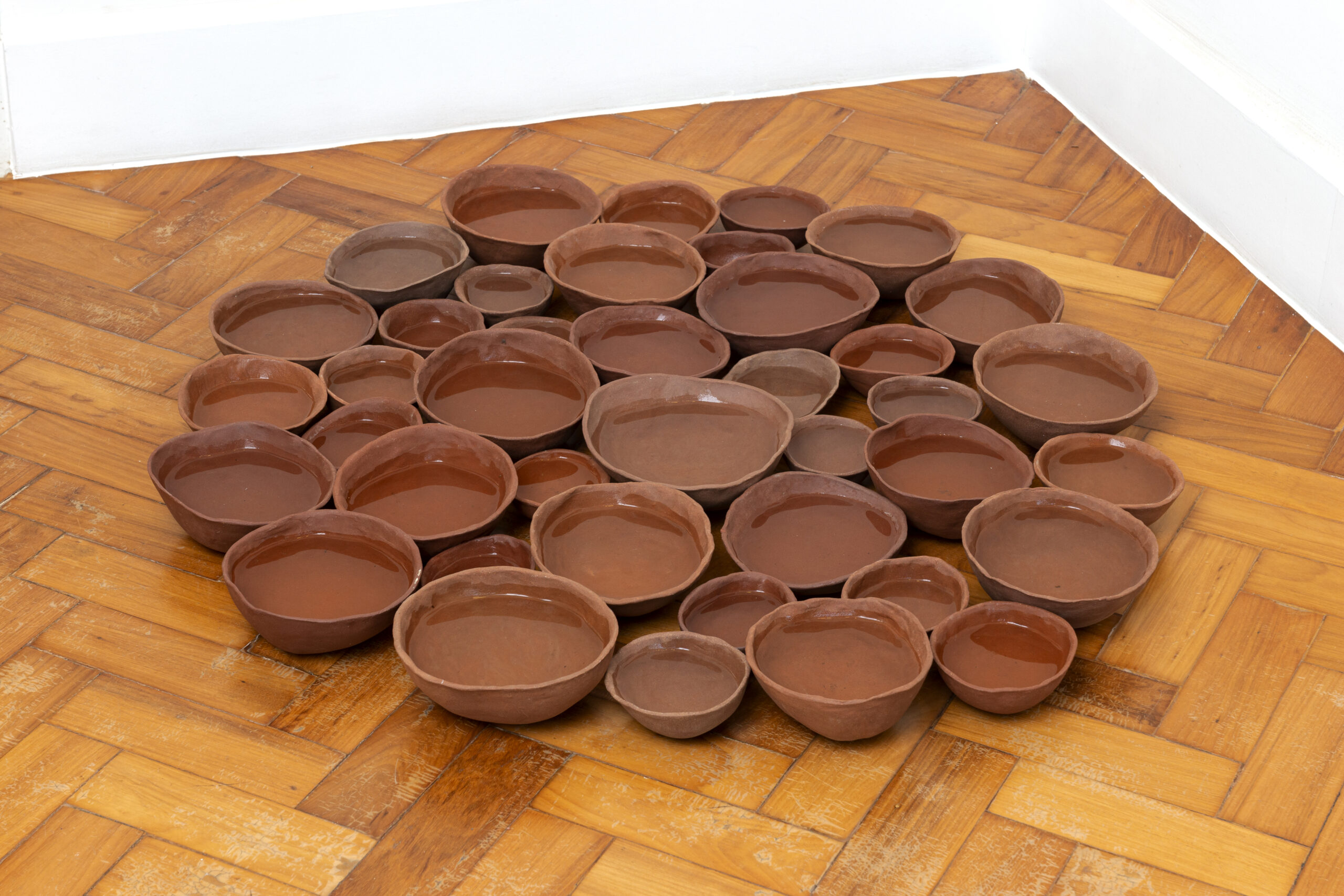
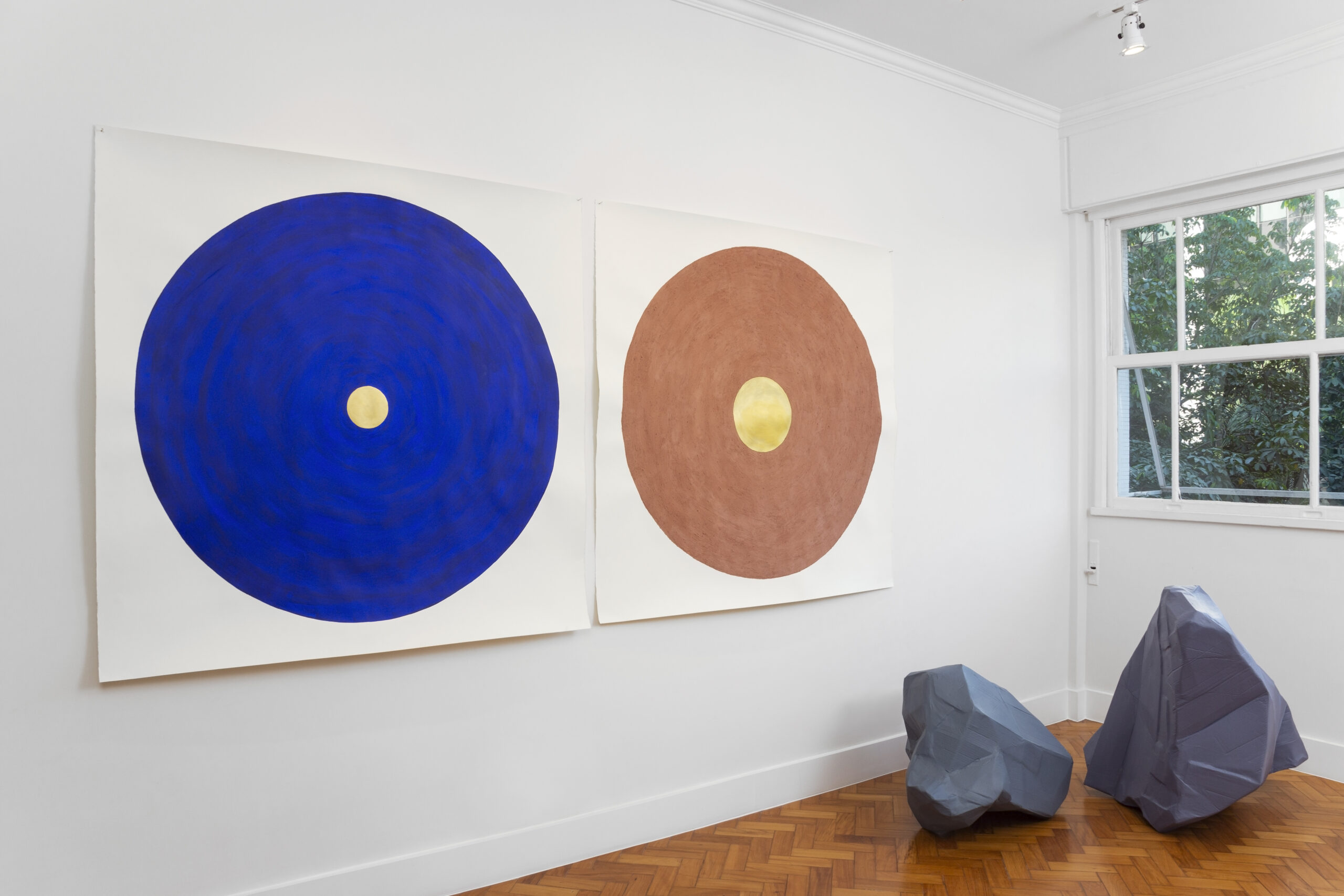
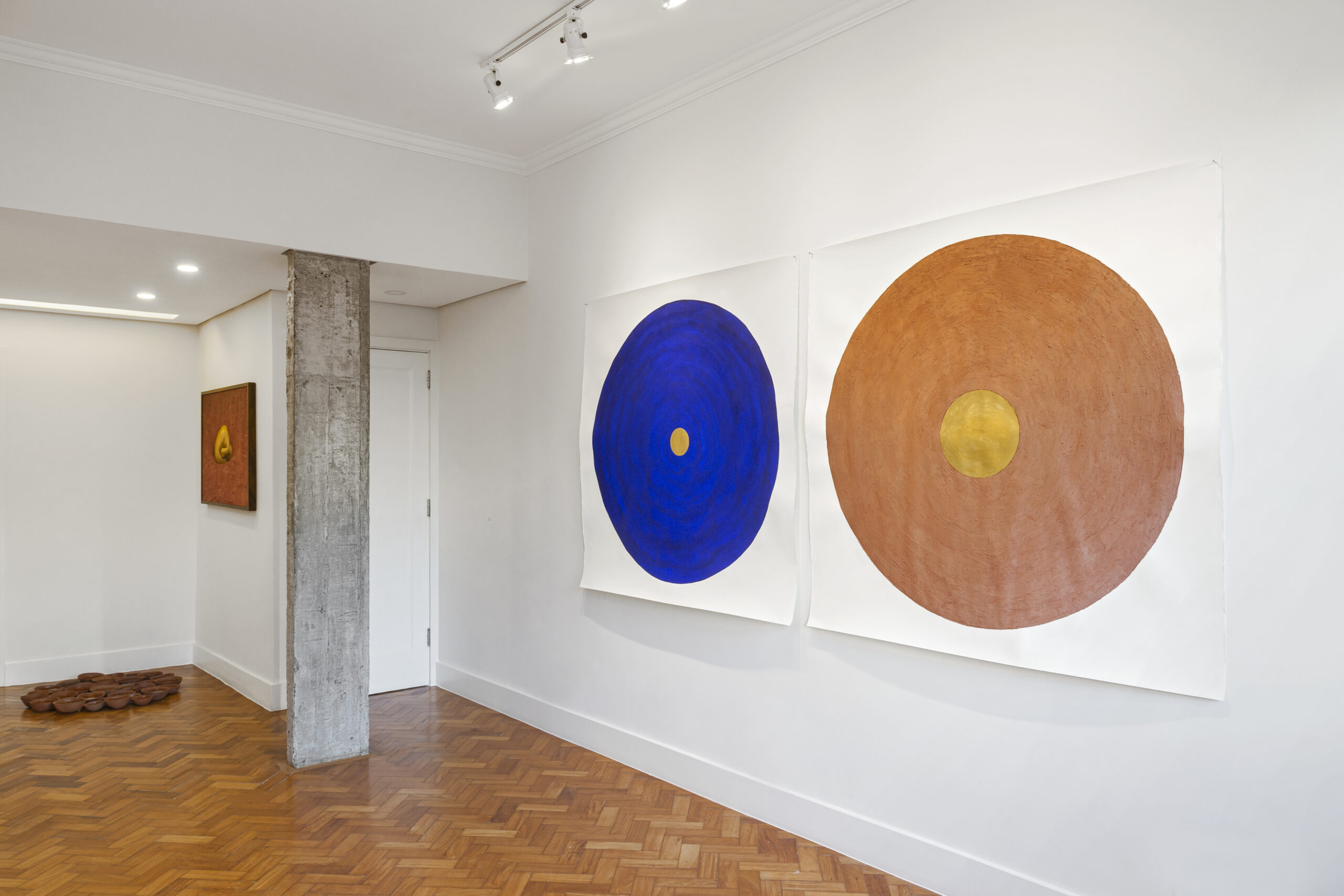
It is based on this reasoning that his drawings remove any information that is not concentric, as exemplified by the diptych, Point of Convergence. In it, instead of the body-horizon, there is a dot of golden ink on earthy and celestial pigment. However, water gourds set up in a circle on the floor reaffirm that master line in the body/earth relationship. They mark a level analogous to rest or relaxation, drawing a landscape of intimacy.
The set of works by Amanda Mei and Laura Gorski presents us with dimensions of the landscape, based on the idea that the body is part of a relationship that goes beyond the perspective focused on the experienced landscape. But above all, the invented landscape that we hold close to us, a kind of memory or imagined space-time.
Sonia Salcedo Del Castillo